I’m sure everyone is familiar with the story about how Tex Avery’s The Heckling Hare was censored before it was released. The version that has survived for the past 71 (!) years ends abruptly, as seen in the embedded version below.
We know the cut was made. Now here’s where the excrement really hits the fan: what exactly was cut, and why was it cut?
The wild speculation in animation circles is eternal, even when hard evidence turns up. The only seemingly credible story, relayed to historian and Avery biographer Joe Adamson by Avery himself, is that Bugs and Willoughby were supposed to take a second fall. Bugs says, “Hold on to your hats, folks, here we go again!” as the cartoon finishes. The problem, Avery said, was that the “Hold onto your hats” line was connected to a well-known dirty joke at the time, and that’s why the ending had to be cut.
Rumors persist that this censorship was the reason Avery left Schlesinger’s, no doubt originally instigated by a July 2, 1941 Hollywood Reporter article stating as much. It wasn’t. Avery wanted to do a series of live-action shorts, in which animals made wisecracks through animated mouths, and Schlesinger didn’t. Avery ended up at Paramount for a short period in the summer of 1941, involved with the woeful Speaking of the Animals series. Fortunately for mankind, Avery was at MGM making animated cartoons again by September 1941.
All of this was laid out for us by Michael Barrier in Hollywood Cartoons thirteen years ago. But what’s this got to do with The Heckling Hare? Well, there is a footnote, on page 609, where he gives information taken from a dialogue transcript written and copyrighted at the time the cartoon was made. I quote from that endnote:
A dialogue transcription […] indicates that Bugs and the dog originally took two more long falls after the first one, with the cartoon finally coming to an end during the third fall. If Schlesinger did order the cut, he was not acting arbitrarily.
That satisfied my curiosity over how The Heckling Hare originally ended. I’ve read literally hundreds of documents like the one he described. They weren’t written by fanbois, but by clerks whose job was to type up a literal transcription of what was happening onscreen in a particular film that had been registered for copyright. Sometimes they were devoid of detail. Often, they just transcribed what was being said by the characters (as is the case with most of the Paramount cartoon synopses I’ve seen). On the other hand, MGM must have had a really ambitious friend, as their cartoons have the most detailed of all copyright synopses.
The goal now is to find an actual print of that version of The Heckling Hare.
But wait… It didn’t end there! No, doubt still persists. Barrier is wrong, and Avery’s recollection must be taken as law. Barrier must have misread that dialogue transcript. And how does he know what that document actually is?
Well, fortunately, Mike took the time to defend himself (when he didn’t need to) by scanning that document. I present it here: a dialog transcript for The Heckling Hare, copyrighted in 1941 and transcribed by a Ms. Katharine Lewis.
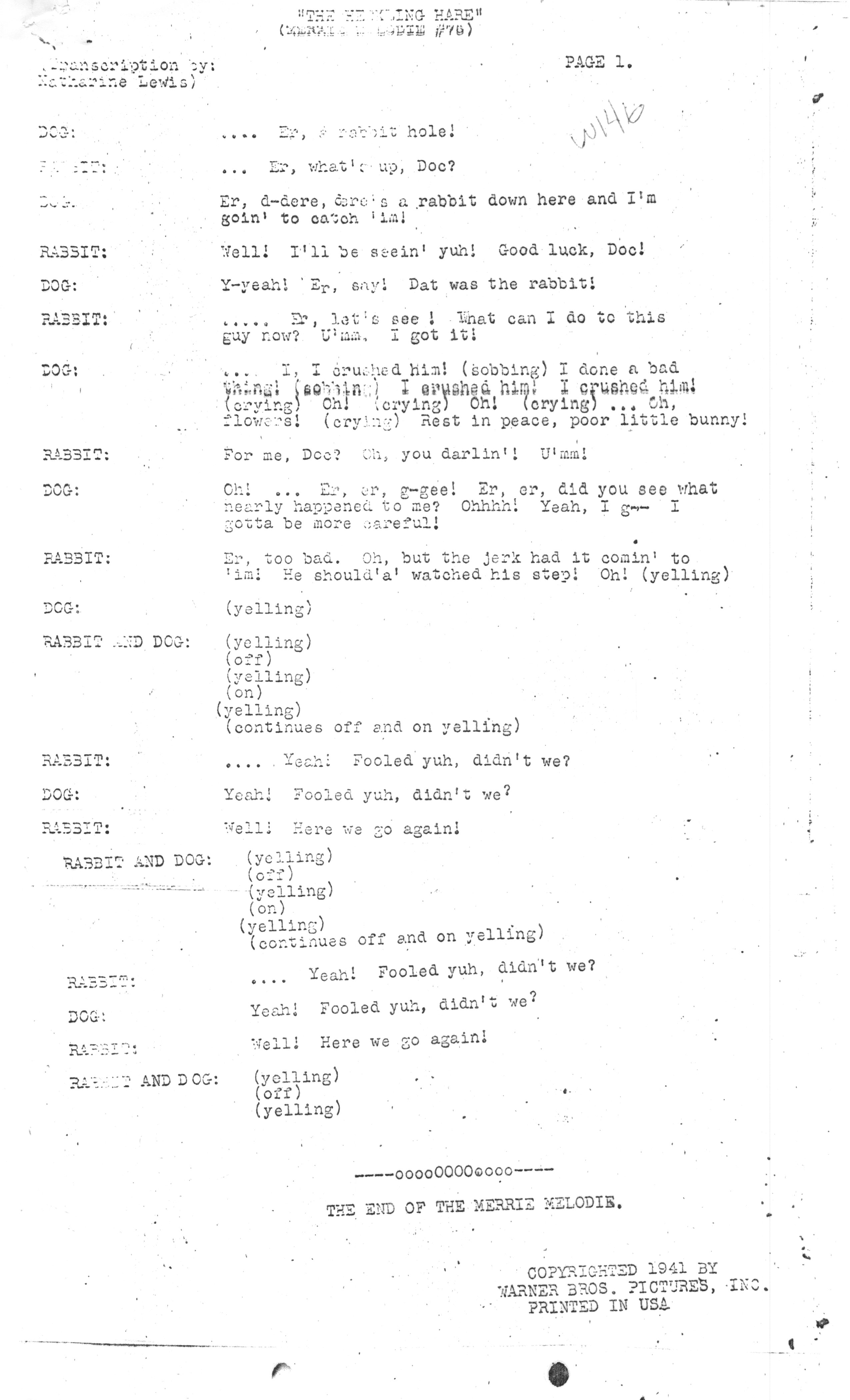
So there you go. Three falls. Mike Barrier, as he usually is, was right. No mention of holding onto any hats, either. And it also matches all of the dialogue spoken in the surviving Heckling Hare, too.
My interpretation of the conflicting stories: Avery was having selective memory loss. Avery, being more daring than the other directors at the time, was obviously trying to test the audience’s patience with the film’s original ending, all for a huge laugh. It obviously backfired severely if even the studio brass knew his ending of three falls was a dud, and Avery must have felt embarrassed by his failure. Hence his misstatement years later.
Now that it’s settled twice and for all, the postulation should end and we researchers can redirect our efforts to actually finding this and other potentially lost Warner footage. Perhaps everyone in cartoon-land can stay grounded in solid fact in the future?
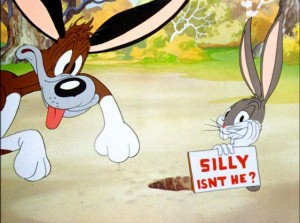
Well, Tex had the answer for that one right, for sure.
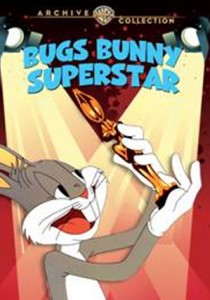 Recently released by the Warner Archive on-demand service was the 1975 film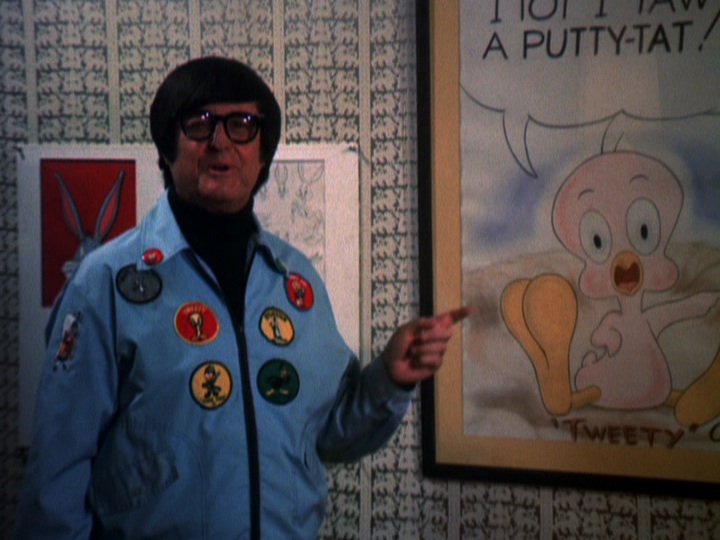
 Thanks to historian and voice artist Keith Scott for providing me with some incredible research material that has allowed me to fill in many holes in