Category Archives: classic animation

Boop-Oop-A-Don’t

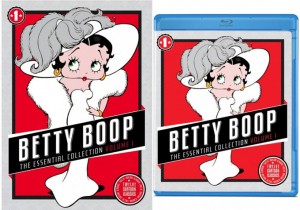
I have a number of reasons to be skeptical about the announced Olive Films’ Betty Boop: The Essential Collection Vol. 1, to be released in July. Not that anything Olive has done in the past makes me wary, as I own a number of their releases and the transfer quality is consistently excellent. Rather, it’s what they’re doing now that is furrowing brows.

Most apparent is that that selection of cartoons not only seems hastily done, but it lacks genuine historical insight. Albeit, most of the cartoons are wonderful, but it’s not nearly as representative as it should be. For a premiere volume, one would think a few of the cartoons animated by Grim Natwick, Betty Boop’s creator, would have been included. But this selection starts after Natwick left the studio. None of the cartoons with Cab Calloway or Louie Armstrong (which would obviously entice a wider audience) are on this premiere release either.

The titles planned for future volumes, as David Gerstein writes, seems arbitrarily limited to the Betty Boop series or what’s been released before as part of the 1995 anthology film Betty Boop Confidential, with a few public domain selections based on those rules thrown in (which leaves out over 30 Talkartoons or Screen Songs starring Betty).

That lack of savviness surely stems from the fact that none of the roundtable of animation experts are involved with Olive Films. A fair amount of noise has been made over the fact that Jerry Beck is not a consultant on this project. That’s not to say Jerry’s involvement is a cure-all, but his absence is not exactly a mark in any project’s favor, nor is the fact that Jerry knows no one calling the shots on this release.

This kind of thinking is fairly typical with the big players, of which Warner Home Video is certainly the worst offender. “We know everything and you geeks don’t know what the hell you’re talking about.” Well, maybe if those geeks were making more of the final decisions with basic (and free) advice, we wouldn’t have faded Eastman Tom & Jerry cartoons mastered in high-definition or Blue Ribbon versions of Warner cartoons when readily available original elements exist. Therefore it’s a little disheartening that this mindset is alive at a smaller player whose intentions seem earnest.

One example of how this will work against them, re: Betty Boop: the Paramount logos for all of these cartoons could easily be reinstated from private collectors’ materials relatively inexpensively (especially compared to what UCLA charges for use of their materials), but it seems obvious we’ll have those pointless U.M.&.M. logos and jump cuts blaring from the HDTVs soon enough. Just a little effort and acceptance would surely result in better sales and more favorable reviews.

I hope that I’m very wrong. The oeuvre of early sound Fleischer cartoons is the second-most important one in classic animation still in dire need of a strong release (the first and foremost, of course, is that of the Tex Avery MGM cartoons). But I doubt this will be it.

Update: Amazon pre-order links now available: Blu-Ray and DVD. I can understand the costs of licensing copyrighted works, but they could’ve filled it up with more content than this for $19.99/$24.99. The Thunderbean DVDs cost next to nothing and Steve Stanchfield literally makes those by himself. If I didn’t know any better, I’d think Olive Films was the amateur outfit…
6 Comments

Filed under classic animation

Belated Clampett Thoughts

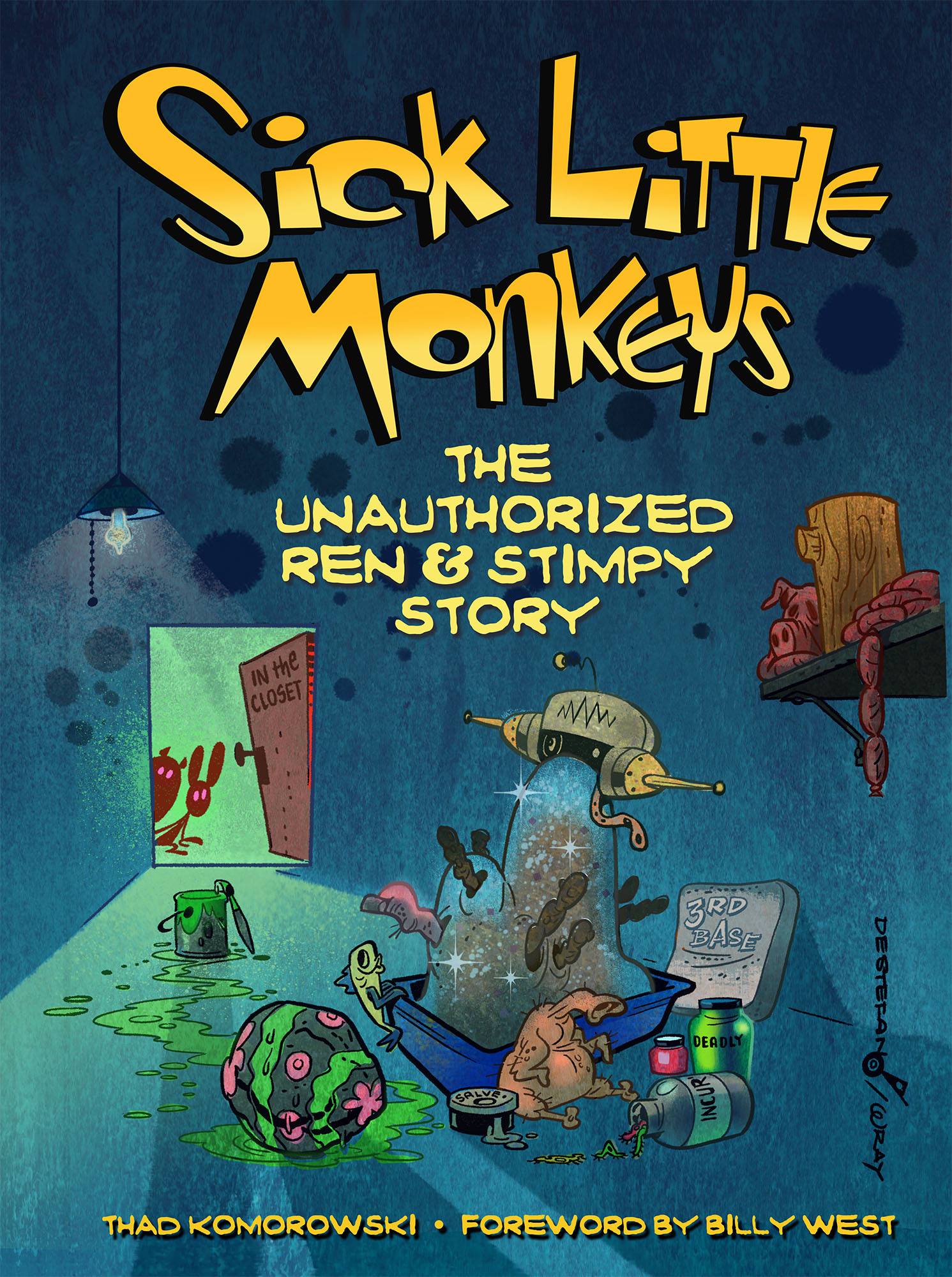
Once again, this blog comes last as my disarrayed life settles. I’m laying the groundwork for a new book on a classic studio you all love, as well as an expanded, revised, hardback edition of Sick Little Monkeys. Those egregious typos will be eradicated, even more information will be added, and yes, a few errors will be corrected, thanks to Tom Minton and Stephen DeStefano for bringing them to my attention. (The most glaring, for the record: Ted Bakes One, the interstitial done by John Kricfalusi and Bill Wray for Channel Zero was made in 1981 and not 1979 as I state. And due to my mis-shuffling of sources and wording, I incorrectly stated that the Bakshi studio was located in Van Nuys during the first season of Mighty Mouse. It was in fact in North Hollywood. Bakshi, after he severed his partnership with John Hyde, relocated to Van Nuys for the second season.)

I also missed out, as did most of the online world it seems, on posting about the centennial of Bob Clampett’s birth, which fell on May 8th last week. Just as well, as I didn’t have much on my mind to say about him then, beyond what I commented on Mike Barrier’s site.

Mark Kausler, that great animator and historian whom I compared to Clampett as far as generosity and animation knowledge were concerned, further demonstrated his kindness by graciously pointing out, via e-mail, that I had flubbed one of my animator IDs years ago. In the Internet age, the single thing websites and blogs (authored by serious people anyway) have over print media is that misinformation can be corrected with the click of a button.

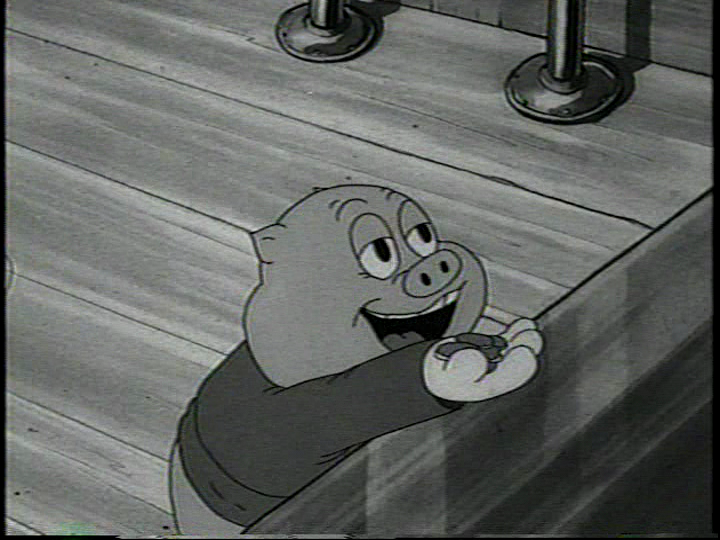
I’d been under the impression the animation of Porky Pig in the malt shop in Tex Avery’s important film The Blow Out, pictured above, had been by Chuck Jones and I stated so at least once without being corrected. Mark says the animation was actually done by Bob Clampett. He said he used the one piece of Clampett’s animation from the period that is verifiably his, the fat lady’s “Sally Rand” dance in (Page) Miss Glory, as reference. I value Mark’s opinion on these things more than anyone else, so I’m not going to second guess him or grandstand until he provides further evidence. If Mark Kausler says so, it’s true.

Clampett never had much to say about his actual work as a draftsman or an animator, be it in interviews or chitchat with those like Mark who knew him. Frankly, judging by the animation that’s verifiably his, he was a pretty damn good animator by 1936 standards, one who could illustrate real life in both the drawing and characterization, and on par with anything Jones was able to do at the time. (Well, from what Mark has told me is verifiably Jones’s anyway…) Certainly nothing to be ashamed of, so why would he write it off?

I can only guess that it’s because he clearly became increasingly disinterested in works that weren’t 100% attributable to his vision. That animation for Avery (and to a far lesser extent Jack King) was in response to another filmmaker’s direction. Certainly he’d acknowledge (as did the other guys) that he did important animation in Porky’s Duck Hunt, but that was an exception. Likewise, he became dismissive of his crew’s skills on the black-and-white Looney Tunes when he knew more money and artistic license was just across the lot. Whatever rough edges they have, a well-crafted entry like Porky & Daffy, Porky in Wackyland, or Porky in Egypt did not exist after the first year or two of Clampett’s tenure as a Warner director, when he clearly became exhausted with his surroundings.

To bring up another B.C. historical dilemma, where are the Clampett drawing from when he finally got his own “A” unit? I have seen plenty examples of Clampett’s draftsmanship from his black-and-white cartoons, and they are energetic and functional. But never a single one from his color cartoons, the “energy sketches” as described by Bob McKimson and Phil Monroe. Given Clampett took so much of his own (and other people’s) art with him to the grave, I can only suspect he was embarrassed by the haste and roughness of whatever drawings he did as a director in the ’40s. Again, they were probably nothing to be ashamed of. Friz Freleng’s own drawings exhibit similarities in their genuine, painstaking effort to get an emotion across. Both men also relied on other artists to pick up the drawing slack because their skills were better elsewhere – and both clearly knew what they were doing.

Given that level of personal investment, it’s therefore striking that so many Clampett cartoons really don’t hold up as wholes, yet I can’t bring myself to actively dislike them. Hare Ribbin’ and Draftee Daffy are two that come immediately to mind, to name two popular examples, that are so loaded with sloppy execution and mischaracterization that I really should be tearing them apart, but dammit, I can’t bring myself to do anything except adore them. (By the way, does anything go on in the latter beyond Daffy running around the house for four minutes?) Like Nick Ray, Clampett was a largely uneven filmmaker for a better part of his career, yet also charismatic and such a pure artist and entertainer that it’s easy to forgive any aesthetic blunders. Other directors may have been sturdier, but they were also more predictable. True, unpredictability doesn’t create greater art by default – but the heights of an artist’s peaks surely count for something.

I mean, what case can be made against the guy who gave the world this? Really?

4 Comments

Filed under classic animation, dead guys

Marsupial Mayhem

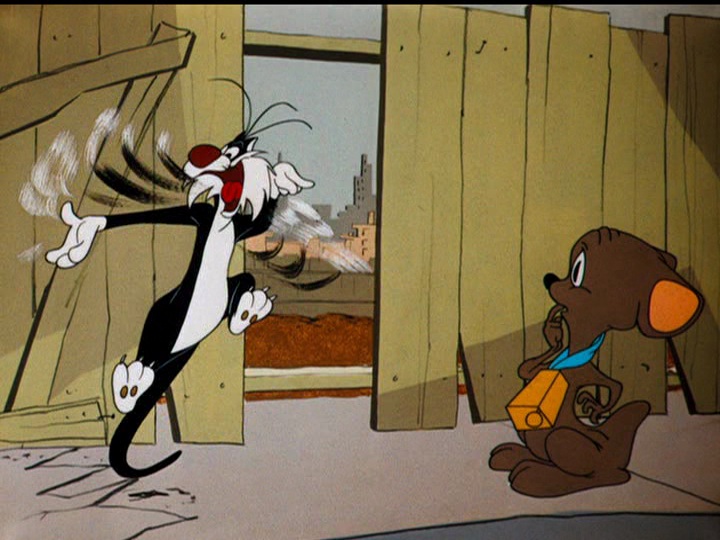
My review of the latest Looney Tunes Super Stars DVD, Sylvester & Hippety Hopper: Marsupial Mayhem, is now online at Jerry Beck’s Animation Scoop. You can view it at this link.
4 Comments

Filed under classic animation

Supervised by Fred Avery


Please visit my friend and colleague Frank Young’s new blog devoted to the cartoons Tex Avery directed at Schlesinger’s. As proven repeatedly on his soon-to-be retired John Stanley blog, Frank is an excellent critic and analyst of the popular arts. He’ll be going through the Avery WB shorts in order of release and already has a microscopic examination of Gold Diggers of ’49, a cartoon that, by his own admission, isn’t very good in spite of its historical significance.

I agree with Frank that the Avery Schlesinger shorts were the most important in pulling the animated cartoon short out of its acquiescence to Disney in the 1930s. They may falter stacked against his filmography at MGM, but that’s only natural since Avery was developing his style and skill during his Schlesinger tenure.

1 Comment

Filed under classic animation, people