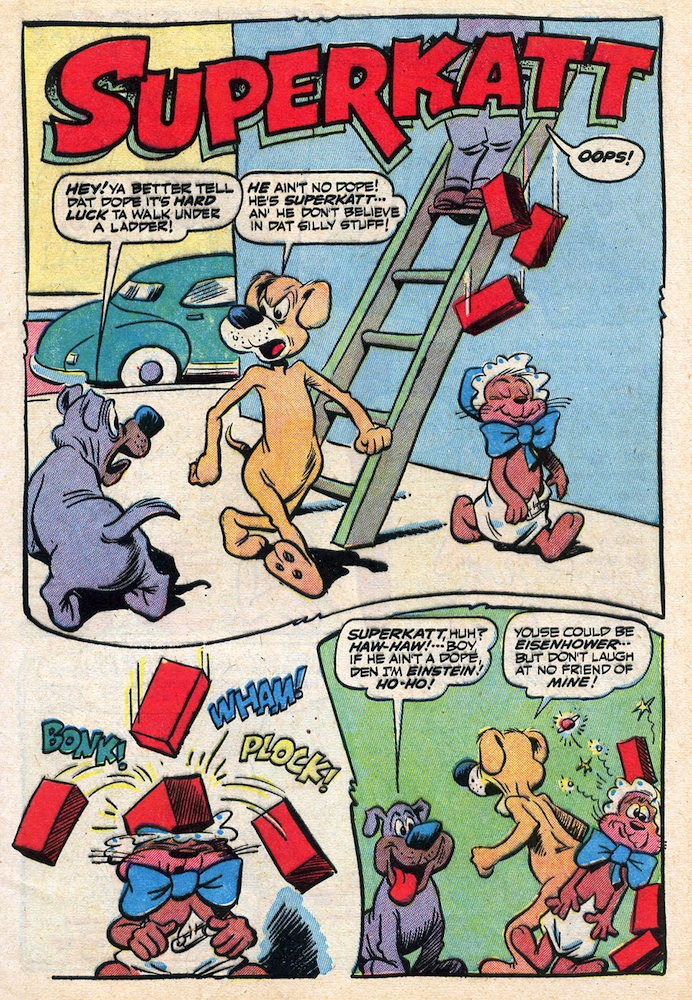
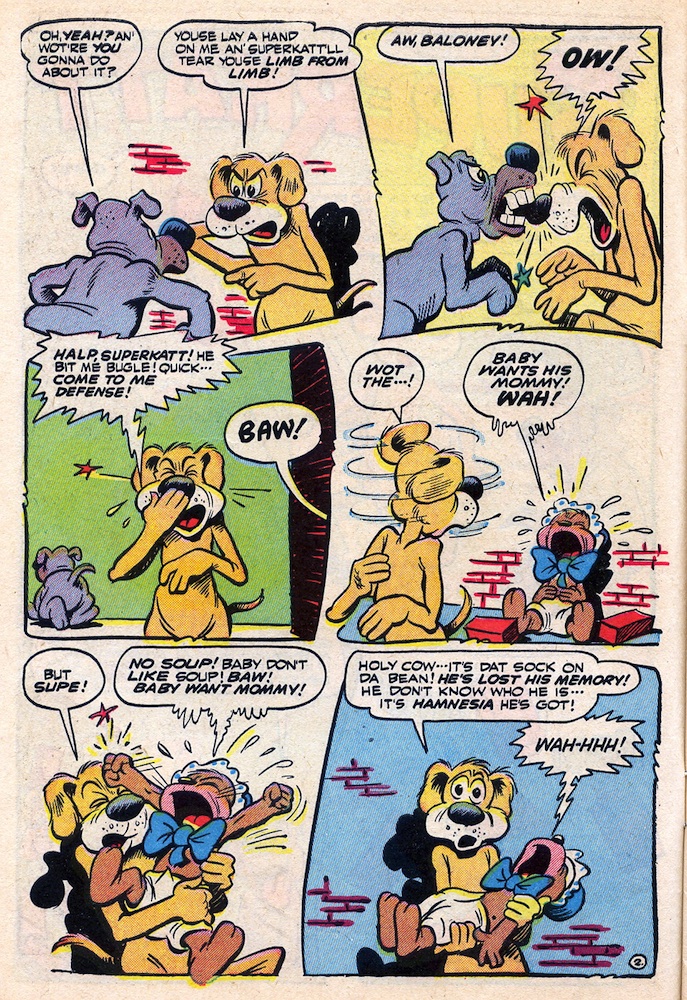
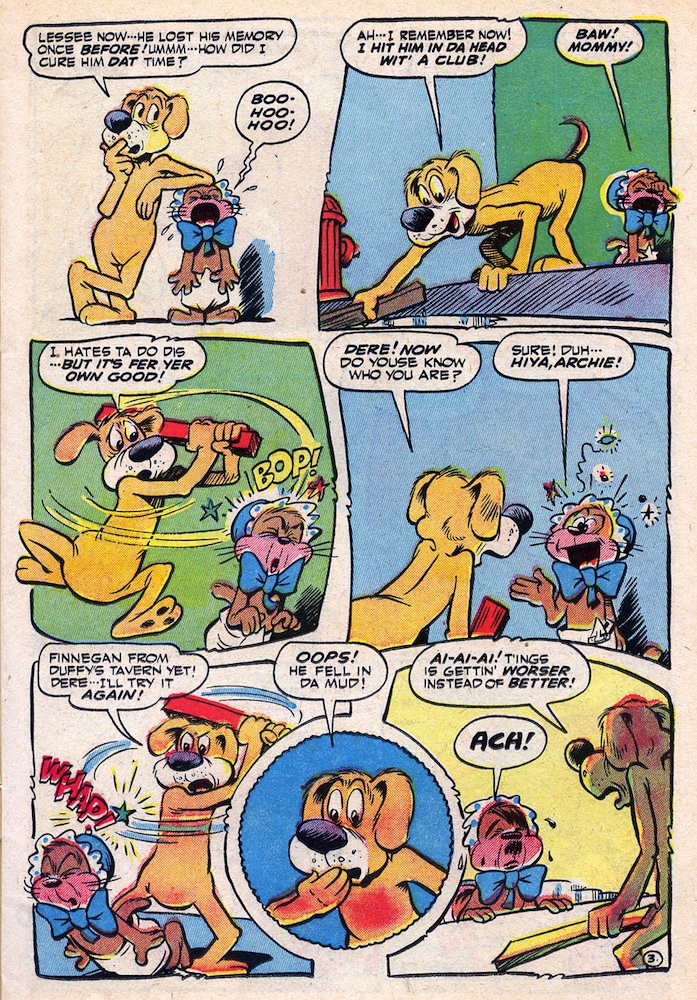
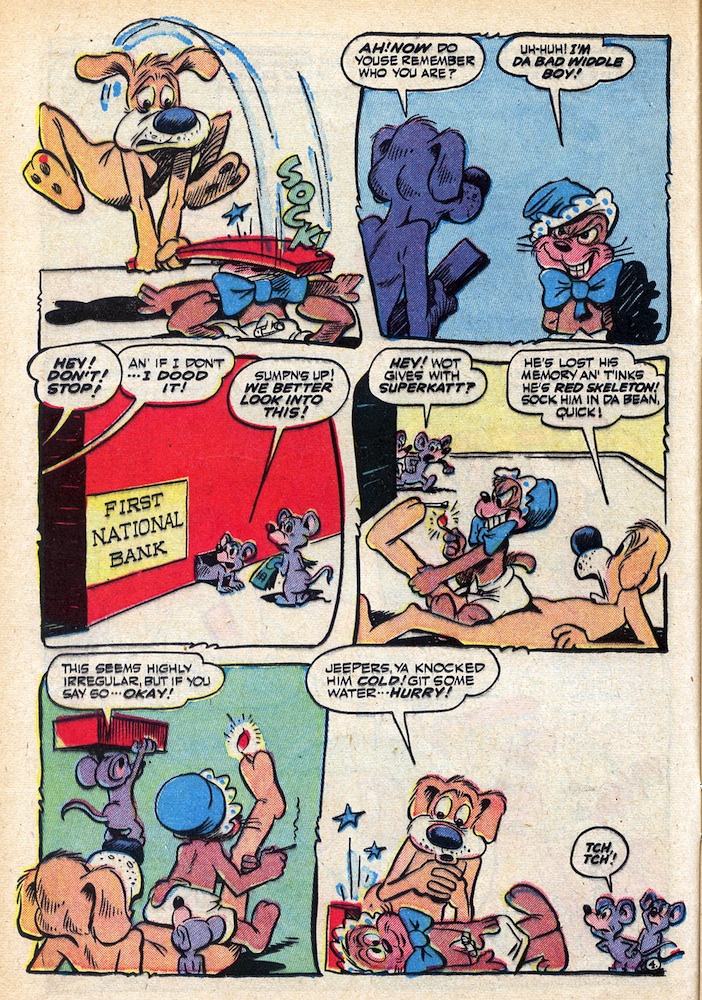
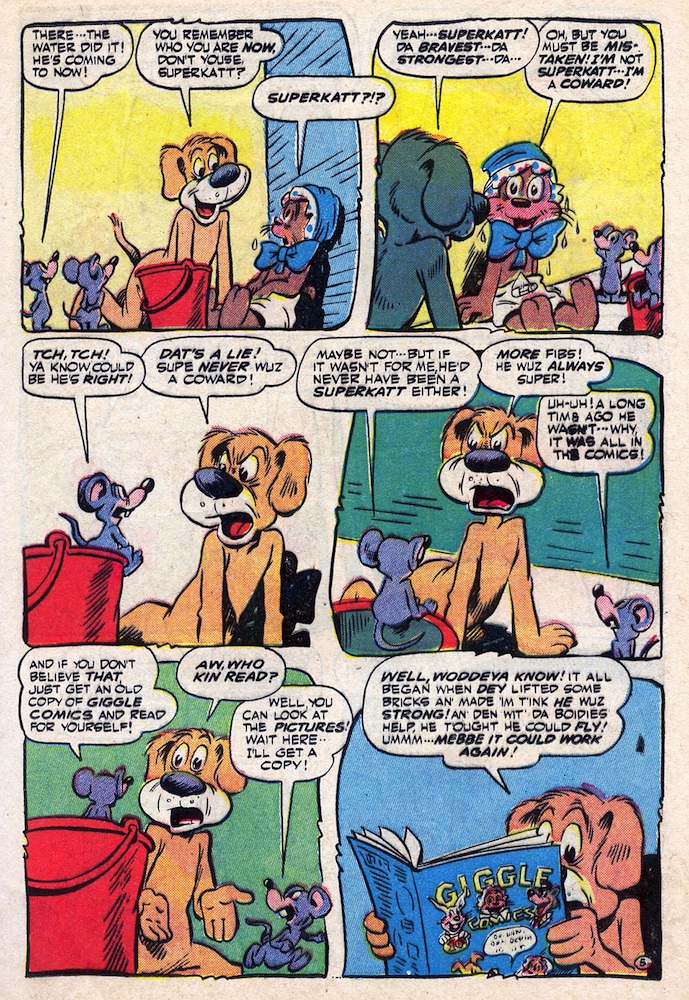
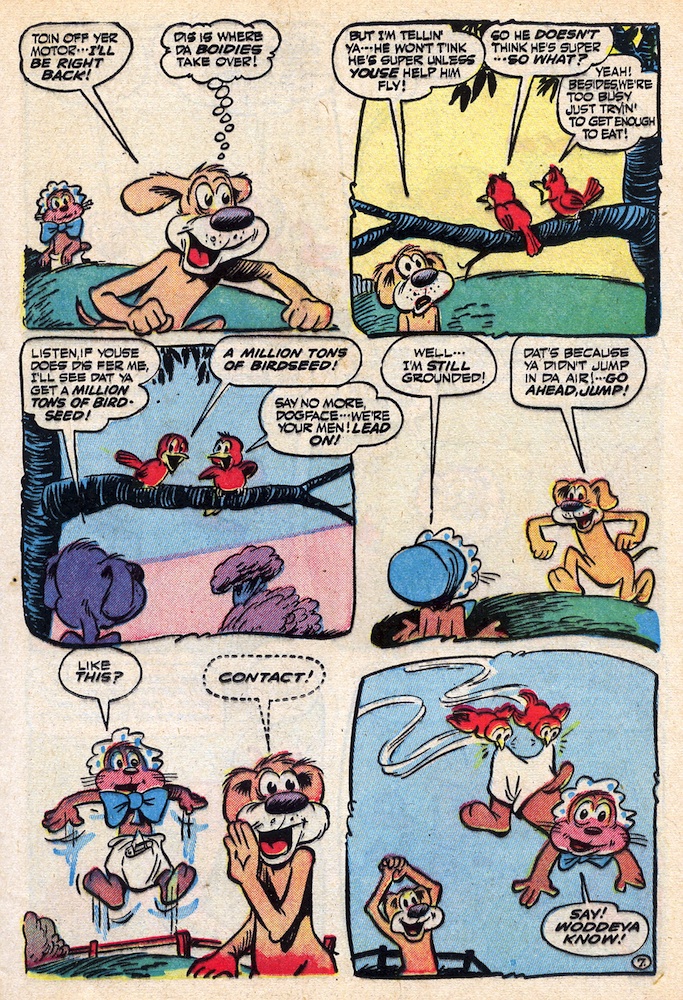
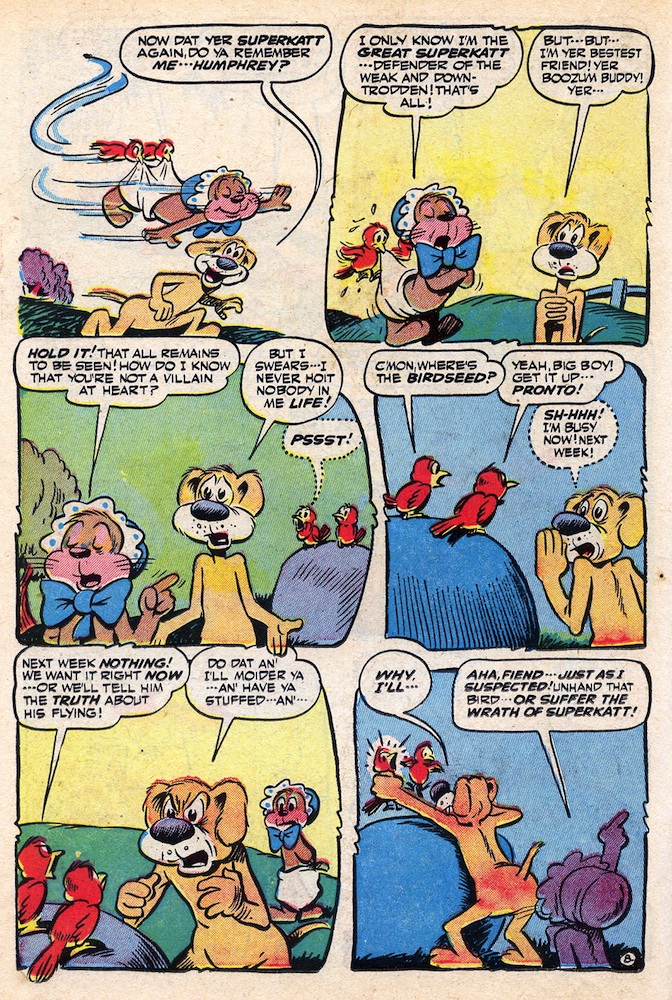
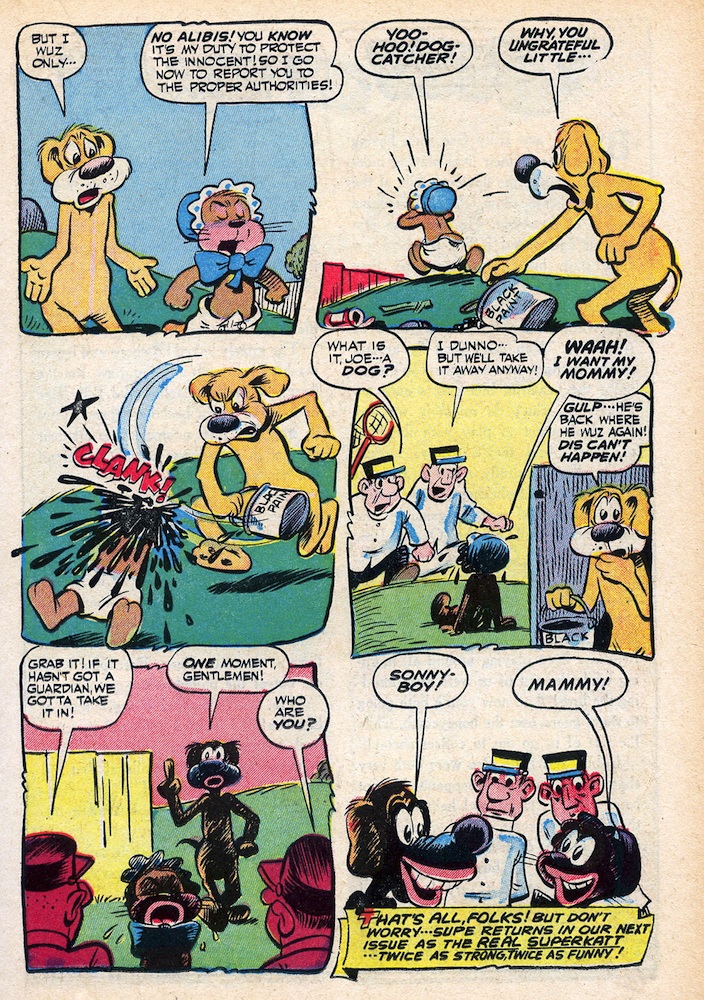
Not a whole lot is known about the life and times of Dan Gordon, but much of what’s identifiable as his work is fairly phenomenal in its execution. The brilliant, unconventional Popeye cartoons (like this one) bearing his name as “director” may be the only time a Golden Age Paramount short actually properly credited who was at the helm of the cartoon. His comic book work is very much the same as that directorial work, with seemingly normal stories abruptly taking a sharp right turn into lunacy; he never seems concerned that the plot is making any logical sense, only that the audience (and himself) are entertained by the hijinks. He ended up, after a hiatus from animation work altogether, doing ‘story sketches’ for Hanna-Barbera, probably the last place such a mindset would be appreciated.
This Superkatt story from Giggle Comics #71 (1950) is a nice example of his working process. Fortunately (?), the All Comics Group didn’t mind the comics getting as anarchic and meta as the theatrical shorts, something obviously kept at bay in the funny animal books of Western. He’s developing an interesting drawing style here; some of the side characters in particular are easily the closest thing to classic MAD Magazine I’ve seen outside of that title (save the work by Kurtzman, Martin, etc. al did themselves outside the title).
Just to take a break from the Looney Tunes posts, here’s another gem from the Hubie Karp-Jim Davis days of the Fox and the Crow from Real Screen Comics #33 (1950). It’s a fairly unique take on the duo’s chemistry, with Crawford putting almost zero effort into his scam; Fauntleroy’s anxiety does all the work. Since we’re in an age when it seems almost every Golden Age comic is being reprinted, how about a book of these guys?
Do yourselves a favor and listen to the Animation Guild interview with the living animation legend Mark Kausler. It’s an insight into how endlessly fascinating and informative a conversation with Mark is, something I had the pleasure of experiencing last March when I visited him with Jerry Beck. (That’s him next to only part of his cartoon film collection. You can see the 35mm rewinds he bought from Don Bluth behind him too – literally everything he has is a piece of history!) Be sure to look at his blog, where he always has great cartoon art and thoughts on display.
I haven’t gotten to reviewing the December release of Foghorn Leghorn & Friends: Barnyard Bigmouth until now, so I’m glad to say that Warner Home Video improved its standards for the [still] half-assed Looney Tunes Super Stars series. Thanks to our many nasty reviews and comments about the first botched batch, the widescreen problem has been amended. Kind of. On this disc, you have the option to watch it in ‘fullscreen’ (the way it was made) and ‘widescreen’. Of course, they still lie to us with a deliberately misleading selection screen:
A more apt comparison would be as follows:
But I digress. The cartoons are still intact, and they all look great. Now the caveat: most of these cartoons aren’t very good at all, and you know things are getting bad when one of the best cartoons in the compilation is from 1963 (the very funny Banty Raids, pictured above). Bob McKimson started his directorial career in 1945 solidly, and got quite a few years of very funny cartoons under his belt. The Foghorn Leghorn series was the cream of that crop, as proven by cartoons like Crowing Pains and The Foghorn Leghorn, where the laughs come not so much from the gags themselves (though they quite often do), but how bombastically they’re played out. After a few years though, before the shutdown even, McKimson got in a real rut, turning out cartoons clearly below the level Chuck Jones and Friz Freleng were.
Most of his great animators (Manny Gould, Pete Burness, Bill Melendez, Emery Hawkins) had already left at that point, and his Bugs and Daffy shorts became real ‘business-as-usual’ pictures. Even the Foghorn cartoons began to slip, with something like All Fowled Up (the last one done before the shutdown, mostly with Jones animators because McKimson’s crew had mostly jumped ship at that point), featured on this disc, barely being able to sustain six minutes. There’s some bright spots if you look for them, like the always endearing animation of Rod Scribner (if you can forgive his talent is clearly not being utilized), but they’re largely forgettable.
This mantra sounds the same as usual, but that’s because it’s absolutely true, and it’s strongly evident with this collection. It’s basically the disc in a later Golden Collection you’d watch least, in that it’s really scraping the bottom of the later Looney Tunes barrel. One thing that became apparent watching McKimson’s cartoons in such pristine shape is how stiff the character animation had gotten. The quality seriously recedes to Hanna-Barbera TV level, with maybe a couple more drawings (the John Seely canned soundtracks on Weasel While You Work and Gopher Broke really drive this point home). McKimson was clearly just going through the motions at this point to get a paycheck. I wonder what was going on with him personally that sucked out all the enthusiasm and sheer joy so apparent in his earlier work.
It took a bit longer for the reality of the dwindling budgets to affect Jones and even Freleng; around roughly 1960 is when an assembly line feel became dominant in most of their respective work. Compare the hysterical Two Crows from Tacos, tag-teamed beautifully between Virgil Ross and Art Davis, to the unbearable Crow’s Feat, a cartoon with no Davis (he had left the studio) and the deteriorating Gerry Chiniquy’s style dominating the picture over Ross and even Hawley Pratt. True, gags and timing is everything (it’s easily one of Freleng’s worst) but shoddy drawing and animation does no one any favors.
So in all, is this disc worth buying? If you truly want to have every Warner cartoon on DVD, absolutely buy it, as there’s some funny moments if you scour through it, like the Mike Maltese scripted Fox-Terror, the most bizarre Foghorn cartoon ever. It’s worth buying if you’re a student of animation too, just to study the deterioration of a very talented animator. But if you’d just like to enjoy the best of what Bob McKimson has to offer, just stick with what’s been made available on the Golden Collections, and hope that some of the brutally funny earlier Foghorns are released restored.